
Draadverbindingen
One-stop-oplossing voor PCB & Montage
- Gold Wire Bonding & Aluminum Wire Bonding
- PCB-fabricage, Parts Sourcing & PCB Assembly
- Box Build Assembly & Electromechanical Assembly
- Kleine tot middelgrote volumeproductie
- ISO9001:2015, ISO 13485:2016 Certified & UL Listed
- 100% E-test, Aoi, Röntgenfoto, ICT & FCT
Wat is draadverbinding?
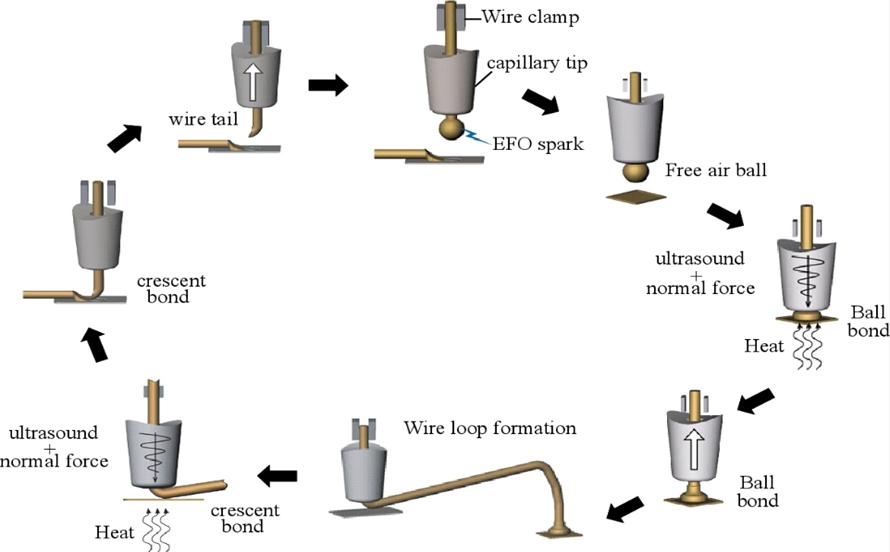
Wire Bonding is het proces waarbij verbindingen worden gecreëerd tussen de chip en het substraat of de PCB, spelen een cruciale rol in de ontwikkeling van moderne PCB-elektronica. Als sleuteltechnologie in de elektronicaproductie, wire bonding maakt het mogelijk betrouwbare circuits te creëren met behulp van metaaldraden zoals goud, aluminium, en koper. De keuze van de lijmmaterialen is afhankelijk van factoren zoals de beoogde toepassing, kostenoverwegingen, betrouwbaarheid, en compatibiliteit.
Draadbindmachines zijn sterk geautomatiseerd, met geavanceerde patroonherkenningssystemen (PRS) die de chipverbindingspads en PCB-referentiepunten nauwkeurig lokaliseren voor nauwkeurige draadplaatsing. Om een optimale hechting te garanderen, de printplaat of het substraat, samen met de chip, moet stevig op zijn plaats worden geklemd met behulp van een vacuüm. Dit zorgt voor vlakheid en stabiliteit tijdens het lijmproces. Vervolgens wordt een capillair gereedschap gebruikt om de draad vast te houden en te verbinden, een betrouwbare verbinding garanderen.
Bij gouden maat, wij bieden hoogwaardige draadverbindingsoplossingen om ervoor te zorgen dat uw elektronische componenten met precisie en efficiëntie met elkaar worden verbonden, bijdragen aan de duurzaamheid en prestaties van uw apparaten.
Wat zijn de verschillende soorten draadverbindingen?
Ultrasone hechting
Thermocompressieverlijming
De voordelen van SMT PCB -montage
PCB -miniaturisatie
Door Hole Technology (Tht) Vereist meer ruimte op de PCB voor componentbijlage, Beperking van ontwerpflexibiliteit. Daarentegen, Surface Mount Technology (SMT) zorgt voor compacter, lichtgewicht, en efficiënte printplaat -assemblages. Dit maakt SMT de ideale keuze voor toepassingen zoals draagbare en draagbare apparaten, waar ruimtebesparende en prestaties essentieel zijn.
Betere elektrische prestaties