


Liaison par fil
Solution unique pour les PCB & Assemblée
- Gold Wire Bonding & Aluminum Wire Bonding
- Fabrication de PCB, Parts Sourcing & PCB Assembly
- Box Build Assembly & Electromechanical Assembly
- Production de petits et moyens volumes
- ISO9001:2015, OIN 13485:2016 Certified & UL Listed
- 100% Test électronique, AOI, RADIOGRAPHIE, ICT & FCT
Qu'est-ce que la liaison filaire?
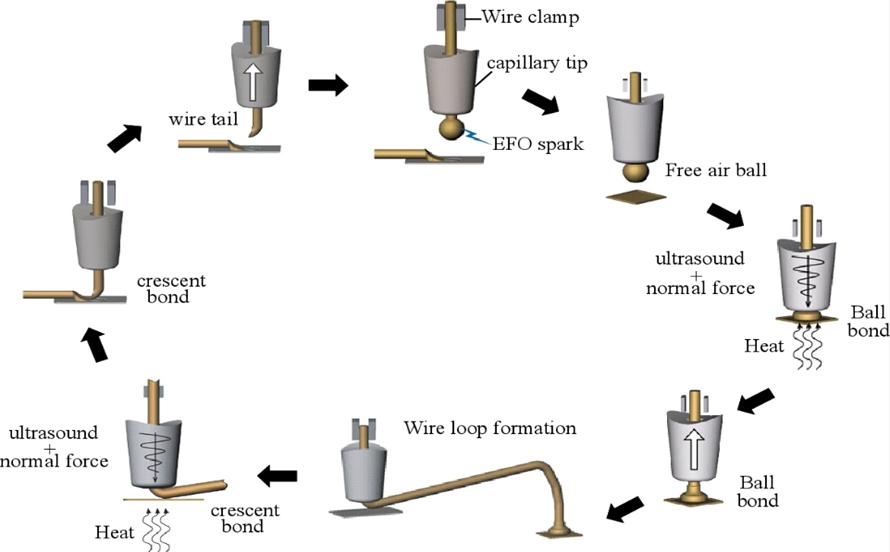
Le Wire Bonding est le processus de création d'interconnexions entre la puce et le substrat ou le PCB., jouer un rôle crucial dans le développement de l’électronique PCB moderne. En tant que technologie clé dans la fabrication électronique, la liaison filaire permet la création de circuits fiables utilisant des fils métalliques tels que l'or, aluminium, et du cuivre. Le choix des matériaux de liaison dépend de facteurs tels que l'application prévue, considérations de coût, fiabilité, et compatibilité.
Les machines à souder les fils sont hautement automatisées, doté de systèmes avancés de reconnaissance de formes (SRP) qui localisent avec précision les plots de connexion des puces et les points de référence du PCB pour un placement précis des fils. Pour assurer une liaison optimale, le PCB ou le substrat, avec la puce, doit être solidement fixé en place à l’aide d’un aspirateur. Cela garantit la planéité et la stabilité pendant le processus de collage. Un outil capillaire est ensuite utilisé pour maintenir et lier le fil, assurer une connexion fiable.
À Gold Mate, nous proposons des solutions de liaison filaire de premier plan pour garantir que vos composants électroniques sont interconnectés avec précision et efficacité, contribuer à la durabilité et aux performances de vos appareils.
Quels sont les différents types de liaison filaire?
Collage par ultrasons
Collage par thermocompression
Les avantages de l'assemblage de PCB SMT
Miniaturisation des PCB
Technologie de trou traversant (Tht) nécessite plus d'espace sur le PCB pour la fixation des composants, limiter la flexibilité de conception. En revanche, Technologie de montage en surface (Smt) permet d'être plus compact, léger, et des assemblages de circuits imprimés efficaces. Cela fait de SMT le choix idéal pour des applications telles que les appareils portables et portables., où gain de place et performance sont essentiels.
Meilleures performances électriques